- The Weird Circular
- Posts
- Ten Ways to Finish (Really, Finish) a Writing Project: Part Six: Make a 6-Point To-Do List
Ten Ways to Finish (Really, Finish) a Writing Project: Part Six: Make a 6-Point To-Do List
Sprint to the Finish Line: Leveling Up the Average To-Do List

Holly Lyn Walrath
December 05, 2025
In partnership with

Welcome back to my series on practical ways to finish your book using the power of psychology. Each post in this ten-part series presents a different method you can try to finally just GET IT DONE and WRITE THE FRIGGIN BOOK. If you haven’t read the other articles in this series, you can check them out below:
Make a 6-Point To-Do List
“I decide on 5 things that are most important to focus on for the year. For me, this year, it's 1. doing great work with current clients, 2. growing my business by getting new clients, 3. speaking and writing about my ideas, 4. promoting 18 Minutes, and 5. nurturing myself and my family. I assign a box to each one of those areas and I write all my to dos in the appropriate box. If a task doesn't belong in one of those boxes but I still think I need to get it done, I put it in the 6th box - the other 5%.”
When I started running, it was primarily because running is the only exercise that helps my busted knee feel stronger. But another main goal was physical fitness. I wanted to feel stronger. I’ve never been an athletic person. I wanted to feel like a person who could achieve things that are hard. I made a list of the things that matter in my life, including my family, writing and creative pursuits, my work, and so on. I realized that I had to make space for my self-care. When I started thinking about running as self-care, something snapped into place.
To me, writing has to have a place in your life for it to matter. I often say in my classes that writing isn’t just a hobby—it is a part of living, at least, for true writers. There are times in your life when you might not have time for writing, and that is okay. Sometimes, things like survival or money or family come first. I’ve found that if I think about writing as a part of my life—as something I do because I love it and it matters—then I am better able to care for myself as a creative person.
I’ve always been a fan of to-do lists. Hanging right now on my fridge is a grocery list, and next to it is the week’s meal plan, a simple list of what I want to make each day. When my spouse asks me what we need from the store, I say, “I don’t remember, it’s on the list.” The list becomes the memory keeper for me—a storage place for things I don’t want to have to remember because they feel too menial. But the funny thing is, if you asked me what was on the list right now, if I really had to remember (Let’s say a mysterious masked man was holding me at gunpoint, some kind of sinister grocery list assassin), I probably could tell you most of the things on the list. That’s because the list also helps me remember.
“It's not enough to be busy; so are the ants. The question is, what are we busy about?”
The mere act of writing a to-do list can be helpful for remembering things that matter. Psychologists call those things “unfulfilled goals”. I love that term because it’s what we’re after in this series. A book that isn’t finished isn’t a failure, it’s just unfulfilled. A 2011 study found that having tasks in your mind that weren’t written down somewhere could actually cause intrusive thoughts (Hi, have they been in my bed with me at midnight when I can’t sleep?). Not only that, the intrusive thoughts actually caused poor performance on other tasks. Making a plan to deal with the unfulfilled goals helped reduce the mental interference. (“Consider it done! Plan making can eliminate the cognitive effects of unfulfilled goals,” EJ Masicampo and Roy F Baumeister, Journal of Personality and Social Psychology, 2011).
Famously, Russian psychologists once did a study that found waiters could only remember the details of orders before they had been served. After they no longer needed to know the information, it went out of their heads. They also found that if someone started a to-do list but didn’t finish it, they couldn’t finish other tasks because their brain kept thinking about the to-do list! (“The Psychology of the To-Do List, Forbes)
My favorite form of journaling is just this: lists. Lists are endlessly useful. You can use them for anything in your writing life. But we’re here to talk about how to Finish The Book. For that, I recommend the 6-Point To-Do List.
You might be thinking: Holly, I know how to make a frigging to-do list. But this isn’t just that. The 6-point To-do list is basically a prioritization exercise. It gives you 6 important goals that you want to complete and then a to-do list of tasks for each goal. The point is to cluster your to-do lists by theme.
To clarify, it’s important to distinguish between a goal and a task. Goals are made up of tasks. Tasks can be done in a short timeframe, whereas goals are much bigger.
This is a great tool to try for a writing project because reaching a writing goal is multifaceted. It’s not just “finish the book,” but there might be several things on the list like “take a writing workshop,” “find a critique group,” “create a weekly writing date with a friend,” and so on.
Here’s a 6-Point To-Do List I recently started. One of my goals for 2026 is to focus more on my art-writing-related projects, and I will be opening a joint art studio with a friend. I always start with a title (the overall goal), and then I write the numbers 1-6. Each of the things on my list is a sub-goal for my overall goal. I can then use each of those to create a smaller, shorter to-do list for each sub-goal.
So for “move in” my sub to-do list might be 1. Gather my art from storage 2. Frame any unframed work 2. Pick up keys 3. Film hanging 4. Decide what supplies to bring 5. Hang bookshelves in the studio, etc.
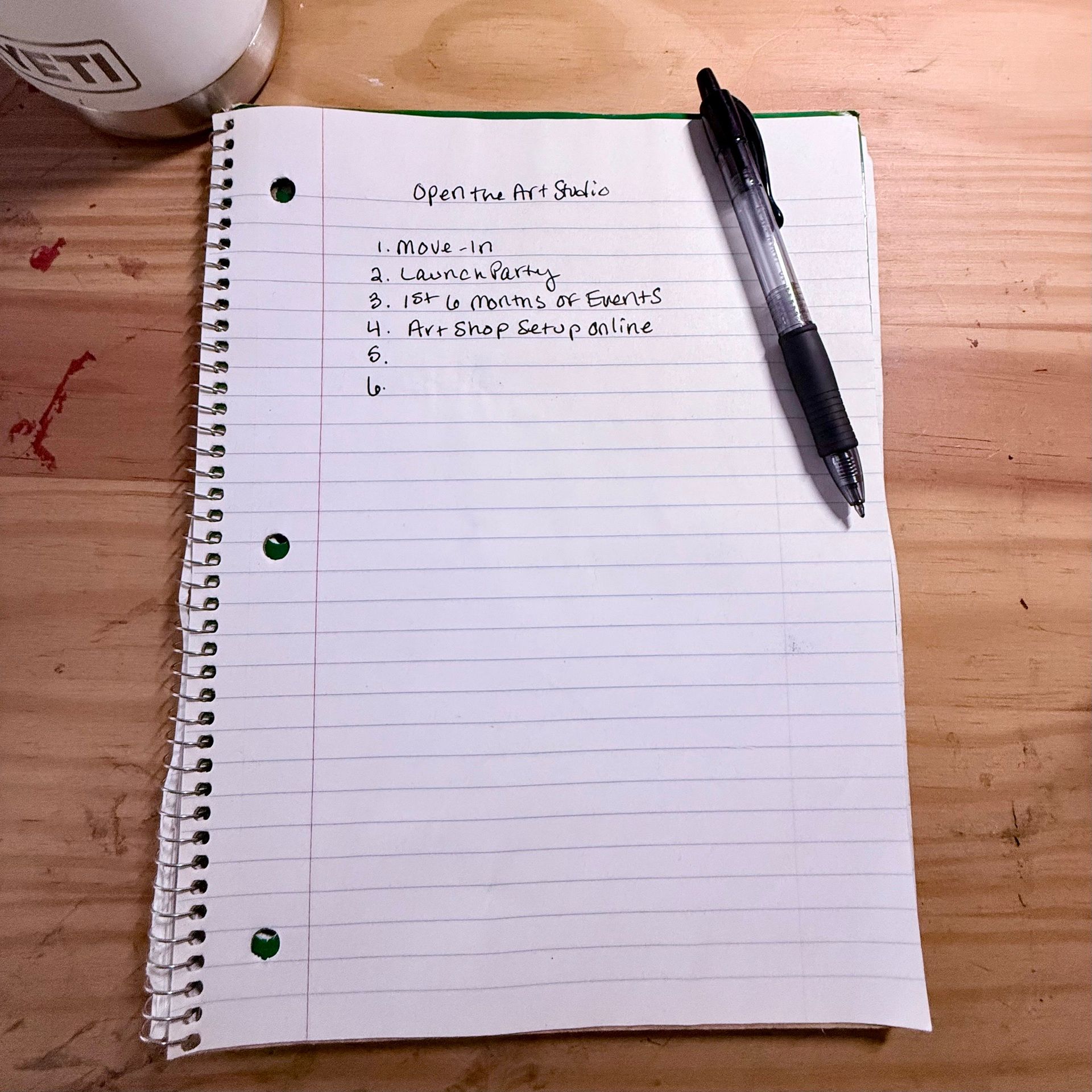
Notice how I didn’t finish my list. I realized everything I needed to do fit under those four sub-goals. I may come back to this list later if more things come up that I need to do.
I find it helpful to make a to-do list each day in the morning before I start my work, but it can also be useful at other times. If you find your mind racing with tasks, you can make one before bed, and research shows you might fall asleep faster.
Are you an overachiever when it comes to to-do lists? If you find that you have lots of things on your list or you make too many lists, it might be helpful to add a “why”: A reason why that task matters to you right now.
I need to finish my book by the end of the year so I can move on to my shiny new idea.
I need to find a critique group so that I can get feedback on my new chapters.
I need to spend more time marketing my book so it can have lots of pre-orders.
And so on. Notice how this is similar to the “If/Then” planning from my previous posts! You will feel more motivated to write if there is a result that will come of it!
Try this journal exercise: Write a 6-point to-do list for your book. Come up with the 6 goals you have as a writer. Now, create a to-do list of tasks that will help you meet those goals.
And now for a word from our sponsor, who helps keep the metaphorical lights on…
Shoppers are adding to cart for the holidays

Over the next year, Roku predicts that 100% of the streaming audience will see ads. For growth marketers in 2026, CTV will remain an important “safe space” as AI creates widespread disruption in the search and social channels. Plus, easier access to self-serve CTV ad buying tools and targeting options will lead to a surge in locally-targeted streaming campaigns.
Read our guide to find out why growth marketers should make sure CTV is part of their 2026 media mix.
Reply